
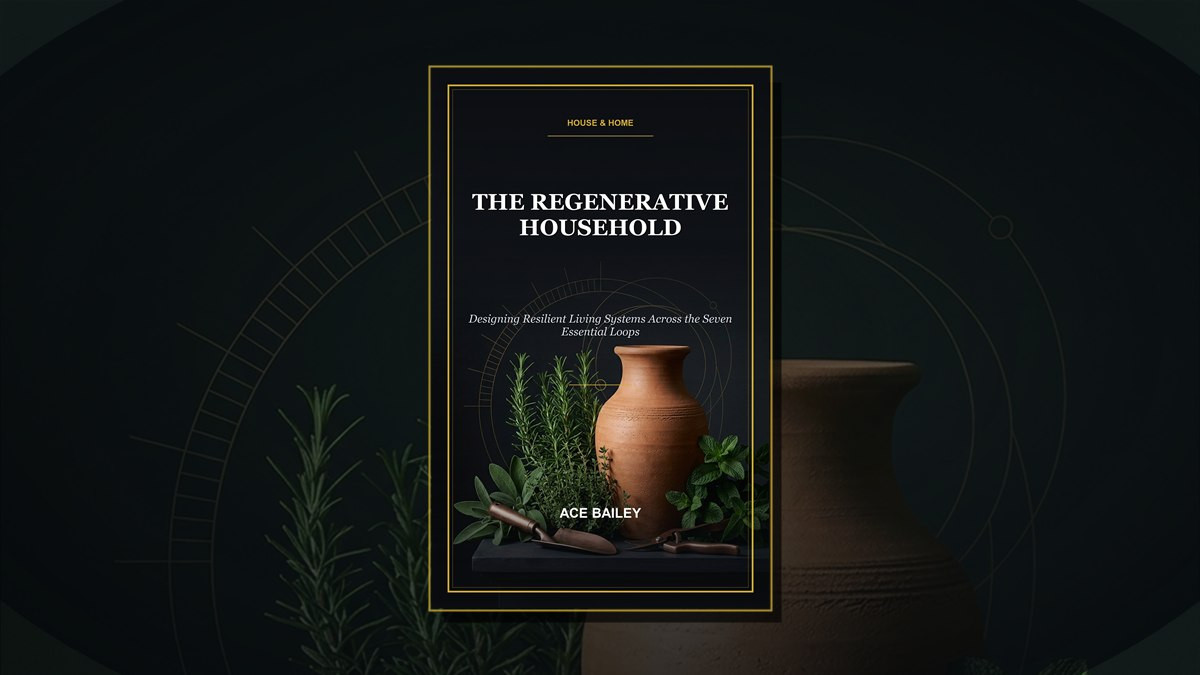
The Regenerative Household: Core Framework, Limits, and Practical Application
How The Regenerative Household works, what problems it solves, where its limits lie, and how to apply its core system in practice.
By Ace Bailey Published November 26, 2026 12:00 PM Updated November 27, 2026
How The Regenerative Household works, what problems it solves, where its limits lie, and how to apply its core system in practice.
Quick Verdict: A home is not merely a place of consumption—it is a living, connected system. In The Regenerative Household, author Ace Bailey provides a practical, technically rigorous handbook for transforming any living space into a resilient, resource-conserving ecosystem. Organized around the Seven Essential Loops—Water, Energy, Food, Materials, Soil, Money, and Knowledge—this book delivers actionable guidance on customary and metric rainwater harvesting calculations, passive thermal zoning, urban soil remediation, greywater safety, hands-on repair economics, and home enterprise accounting.
Bottom Line: Built for Strategic decision-makers, executives, and technical practitioners., this 11-chapter guide prioritizes repeatable mechanics over motivational filler.
1. What Is The Regenerative Household? (Curiosity & Scope)
The Regenerative Household (Designing Resilient Living Systems Across the Seven Essential Loops) is a structured field guide authored by Ace Bailey and published under Independently Published. Rather than offering isolated tips, it organizes the subject into 11 progressive chapters.
2. How the System Works (Clarification & Architecture)
Each chapter isolates a core operational mechanism, tests it against real-world constraints, and translates it into repeatable steps:
- See the Household as a Living System: Core mechanism and implementation steps.
- Assess What You Have Before You Build: Core mechanism and implementation steps.
- The Water Loop: Hydrology, Storage & Filtration Sizing: Core mechanism and implementation steps.
- The Energy Loop: Passive Thermal Envelopes & Micro-Power: Core mechanism and implementation steps.
- The Soil Loop: Thermophilic Composting & Biological Remediation: Core mechanism and implementation steps.
3. How It Compares to Generic Advice (Comparison)
| Dimension | Generic Advice | The Regenerative Household |
|---|---|---|
| Structure | Scattered tips without constraints | 11-chapter progressive system |
| Failure Boundaries | Rarely stated | Explicit limits, failure modes, and stop conditions |
| Execution Format | Passive reading | Checklists, worked examples, and digital companion |
4. Failure Integrity: What This Is Not & When to Avoid It
- What this is not: It is not a magic shortcut or passive entertainment; results require deliberate application.
- Who should avoid it: Readers looking for hype, unverified claims, or licensed clinical/legal advice rather than structured frameworks.
- Cost of inaction: Staying with ad-hoc guesswork compounds avoidable mistakes over time.
5. Frequently Asked Questions
Who is The Regenerative Household actually built for?
Strategic decision-makers, executives, and technical practitioners..
What does The Regenerative Household NOT cover or promise?
It does not promise overnight results without execution or replace licensed medical, legal, or financial counsel where regulated advice applies.
What formats are included on acebailey.store?
Instant digital access via your account library in DRM-free EPUB 3 and digital PDF formats.
6. Next Step (Decision)
You can preview Chapter 1 free and get instant digital access to The Regenerative Household on Ace Bailey Store.