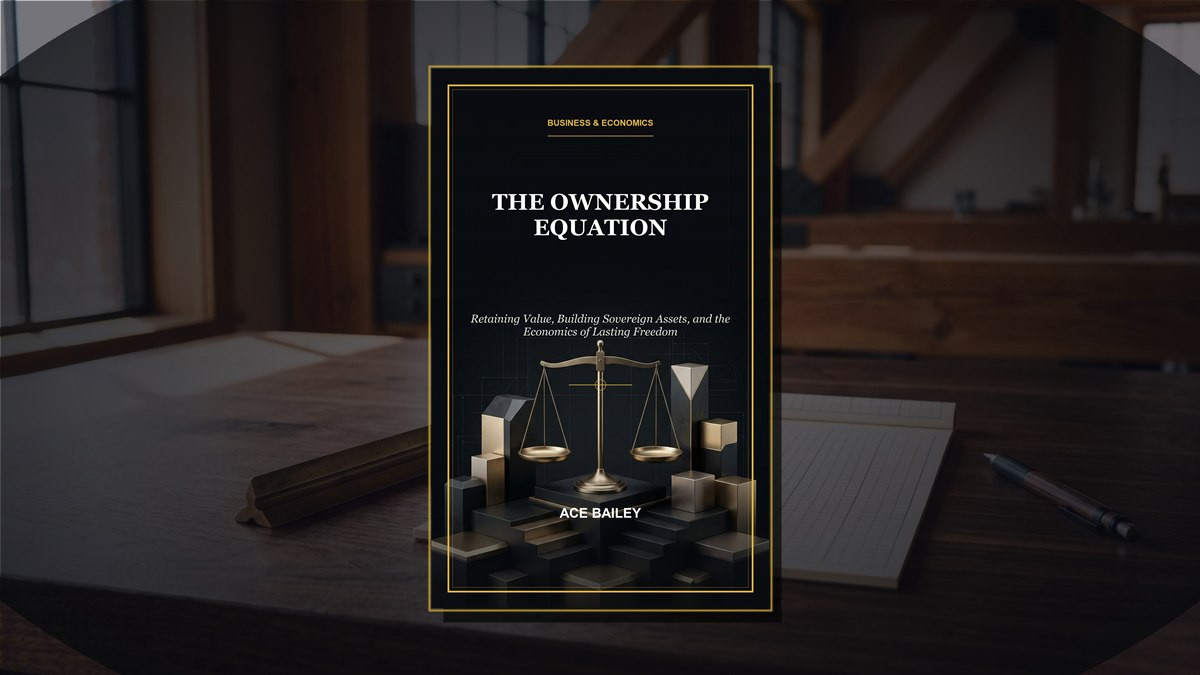
The Ownership Equation: Core Framework, Limits, and Practical Application
How The Ownership Equation works, what problems it solves, where its limits lie, and how to apply its core system in practice.
By Ace Bailey Published November 26, 2026 12:00 PM Updated November 27, 2026
How The Ownership Equation works, what problems it solves, where its limits lie, and how to apply its core system in practice.
Quick Verdict: Income is a temporary flow. Ownership is a permanent claim on future value. In The Ownership Equation, author Ace Bailey delivers an incisive, mathematically grounded economic manual for individuals, creators, and operators seeking lasting financial autonomy. Exploring the four foundational forms of productive ownership—Physical Assets, Financial Securities, Intellectual Property, and Digital Infrastructure—this book demonstrates how to calculate unit contribution margins, payback periods, discounted cash flow, and asset scorecards while managing the operational burdens, platform dependencies, and concentration risks of growth.
Bottom Line: Built for strategic decision-makers, executives, and technical practitioners, this 11-chapter guide prioritizes repeatable mechanics over motivational filler.
1. What Is The Ownership Equation? (Curiosity & Scope)
The Ownership Equation (Retaining Value, Building Sovereign Assets, and the Economics of Lasting Freedom) is a structured field guide authored by Ace Bailey and published under Independently Published. Rather than offering isolated tips, it organizes the subject into 11 progressive chapters.
2. How the System Works (Clarification & Architecture)
Each chapter isolates a core operational mechanism, tests it against real-world constraints, and translates it into repeatable steps:
- Income Is Not Ownership: Core mechanism and implementation steps.
- The Ownership Equation: Core mechanism and implementation steps.
- Four Forms of Productive Ownership: Core mechanism and implementation steps.
- Intellectual Property as an Economic Asset: Core mechanism and implementation steps.
- Digital Products and Zero-Marginal-Cost Distribution: Core mechanism and implementation steps.
3. How It Compares to Generic Advice (Comparison)
| Dimension | Generic Advice | The Ownership Equation |
|---|---|---|
| Structure | Scattered tips without constraints | 11-chapter progressive system |
| Failure Boundaries | Rarely stated | Explicit limits, failure modes, and stop conditions |
| Execution Format | Passive reading | Checklists, worked examples, and digital companion |
4. Failure Integrity: What This Is Not & When to Avoid It
- What this is not: It is not a magic shortcut or passive entertainment; results require deliberate application.
- Who should avoid it: Readers looking for hype, unverified claims, or licensed clinical/legal advice rather than structured frameworks.
- Cost of inaction: Staying with ad-hoc guesswork compounds avoidable mistakes over time.
5. Frequently Asked Questions
Who is The Ownership Equation actually built for?
Strategic decision-makers, executives, and technical practitioners.
What does The Ownership Equation NOT cover or promise?
It does not promise overnight results without execution or replace licensed medical, legal, or financial counsel where regulated advice applies.
What formats are included on acebailey.store?
Instant digital access via your account library in DRM-free EPUB 3 and digital PDF formats.
6. Next Step (Decision)
You can preview Chapter 1 free and get instant digital access to The Ownership Equation on Ace Bailey Store.