You want a structured, plain-English handbook you can download once, read offline, and apply step-by-step.
Skip This If
You are looking for overnight hype, passive entertainment, or licensed medical, legal, or financial counsel.
Inside This Guide
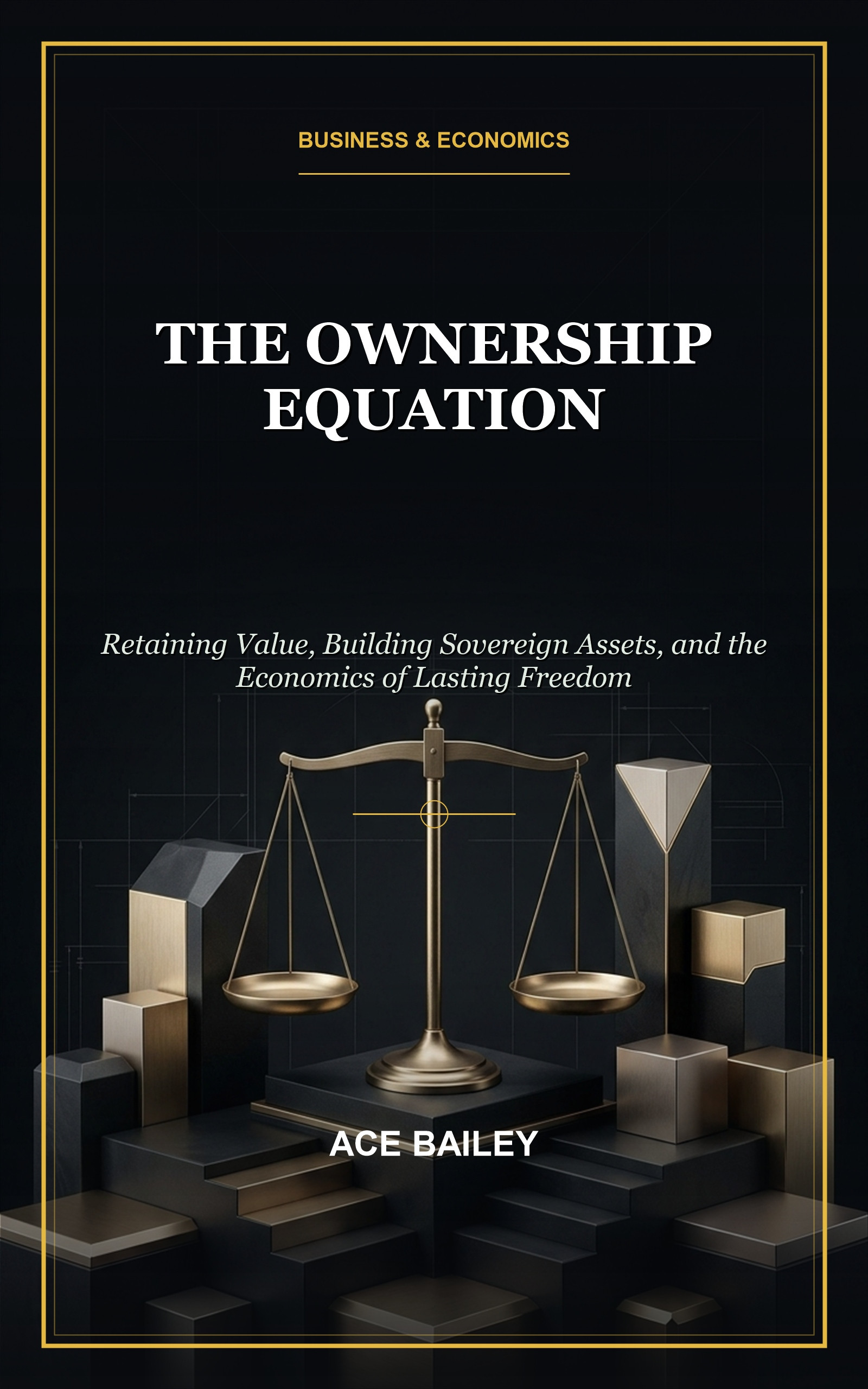
Income is a temporary flow. Ownership is a permanent claim on future value. In The Ownership Equation, author Ace Bailey delivers an incisive, mathematically grounded economic manual for individuals, creators, and operators seeking lasting financial autonomy. Exploring the four foundational forms of productive ownership—Physical Assets, Financial Securities, Intellectual Property, and Digital Infrastructure—this book demonstrates how to calculate unit contribution margins, payback periods, discounted cash flow, and asset scorecards while managing the operational burdens, platform dependencies, and concentration risks of growth.
Inside This Guide
Income Is Not Ownership — Actionable framework and worked examples.
The Ownership Equation — Actionable framework and worked examples.
Four Forms of Productive Ownership — Actionable framework and worked examples.
Intellectual Property as an Economic Asset — Actionable framework and worked examples.
Digital Products and Zero-Marginal-Cost Distribution — Actionable framework and worked examples.
Recurring Revenue Dynamics and Customer Payback Velocity — Actionable framework and worked examples.
Format & Delivery
Instant digital download (EPUB + print-ready PDF companion) from Ace Bailey (Independently Published).
About the Author
Ace Bailey is a capital allocator, commercial systems architect, and author specializing in sovereign asset construction, digital cash-flow modeling, and micro-enterprise valuation.
Related Items
Keep building with related resources from the store.
Listen to Chapter 1 (Audio Preview)
Read or listen at your own pace
Chapter 1 Free Sample
Income Is Not Ownership
A high income can make life more comfortable. It can pay for a better home, reliable transportation, travel, education, and help for the people you care about. But income alone does not guarantee lasting economic freedom. The important question is not only how much money comes in. It is how much value you retain, what you control, and whether some of what you earn can continue producing value in the future.
Income is a flow. Ownership is a claim on something that may keep generating value.
The distinction is easy to miss because a large paycheck feels like wealth. Yet income can disappear as quickly as it arrives. Taxes, debt payments, housing costs, tuition, medical bills, and daily spending can absorb most of it. Someone who earns a great deal but spends nearly all of it may have less financial resilience than someone with a modest income who consistently saves and owns useful assets.
This is not an argument against earning more. Strong income can provide choices and create the means to invest. But earning is only the beginning of the process. To build lasting value, a person must retain some of that income and use it deliberately.
Different kinds of income work in different ways. Active income is usually tied directly to a person’s time and effort: wages, consulting fees, commissions, or payment for a completed job. It can be dependable and valuable, but it often stops when the work stops. A surgeon, designer, or electrician may earn well, yet still need to be present to serve each client.
Business income comes from organizing work, people, and resources to serve customers. A business may generate income beyond the owner’s individual labor, but it also brings responsibilities: payroll, customer service, equipment, taxes, and the risk that demand will fall. Calling something a business does not automatically make it an asset. Its value depends on whether it can operate effectively and produce more value than it consumes.
Royalties and licensing income can arise when someone grants others permission to use a work, design, invention, or brand in exchange for payment. Investment returns may come from interest, dividends, or gains in the value of financial holdings. Recurring revenue may come from subscriptions, repeat purchases, or ongoing service agreements. Each source has its own costs, risks, and conditions. A payment that arrives regularly is not necessarily dependable forever, and an investment that rises in value can also fall.
Asset appreciation is different from cash income. A property, business, or investment may become more valuable over time, but that increase is not the same as money available to spend. It may be uncertain, and realizing it could require a sale, a buyer, fees, or taxes. An owner must distinguish between value on paper and cash actually received.
The central issue is retained economic value: the portion of what an activity produces that remains under your control after its costs and obligations are met. A person may earn a large amount but retain little. Another may earn less but steadily build savings, reduce costly debt, and acquire assets that serve a real purpose.
Consider two professionals with similar incomes. The first upgrades housing, vehicles, and subscriptions whenever earnings rise. Monthly payments grow alongside income, leaving little room for saving. The second keeps spending below income, builds a cash reserve, and gradually buys investments or develops a small business. Neither path is free of risk, and the second person is not guaranteed success. But the habits create different possibilities. One income supports a lifestyle that depends on continued earnings; the other also helps build resources that may provide future income, flexibility, or sale value.
Expenses matter because they determine how much of income can be retained. Some expenses support a person’s health, ability to work, or quality of life. Others may be choices that are affordable only while income remains high. Debt can make the difference more pronounced. A loan used to acquire a productive asset may help create future value, but the payments remain due even if the asset performs poorly. Borrowing to support consumption can leave a person with obligations but no lasting asset to show for them.
Ownership can take many forms. It may mean holding shares in a company, owning a rental property, controlling the rights to a book or software product, or building a business with repeat customers. In each case, ownership gives someone a claim to potential benefits, but it also carries responsibilities and risks. Property needs maintenance. Investments can lose value. Intellectual property may attract no buyers. A business can face competition or changing customer needs.
End of Chapter 1 preview. Get the full 11-chapter digital edition (EPUB & PDF) below.