You want a structured, plain-English handbook you can download once, read offline, and apply step-by-step.
Skip This If
You are looking for overnight hype, passive entertainment, or licensed medical, legal, or financial counsel.
Inside This Guide
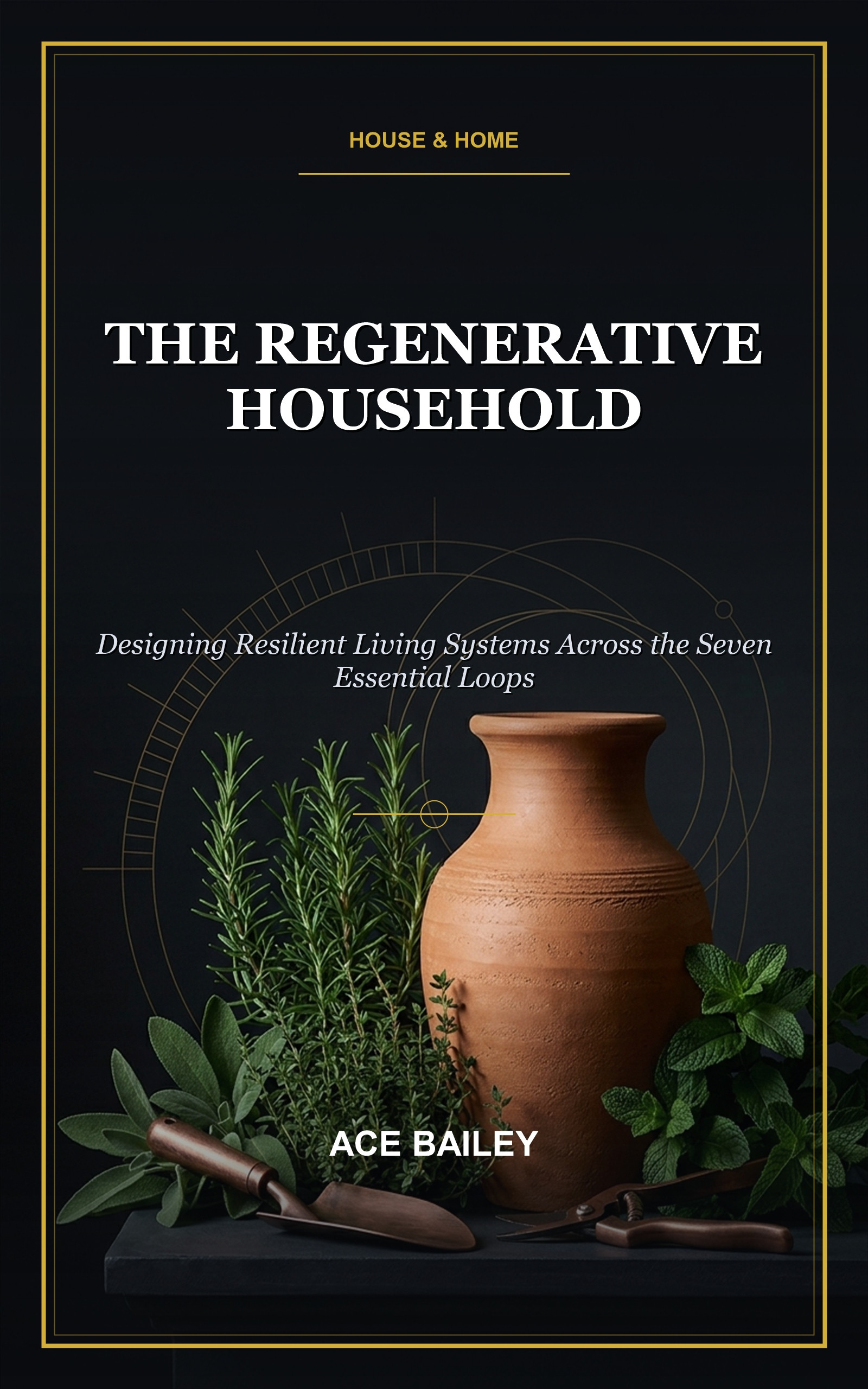
A home is not merely a place of consumption—it is a living, connected system. In The Regenerative Household, author Ace Bailey provides a practical, technically rigorous handbook for transforming any living space into a resilient, resource-conserving ecosystem. Organized around the Seven Essential Loops—Water, Energy, Food, Materials, Soil, Money, and Knowledge—this book delivers actionable guidance on customary and metric rainwater harvesting calculations, passive thermal zoning, urban soil remediation, greywater safety, hands-on repair economics, and home enterprise accounting.
Inside This Guide
See the Household as a Living System — Actionable framework and worked examples.
Assess What You Have Before You Build — Actionable framework and worked examples.
The Water Loop: Hydrology, Storage & Filtration Sizing — Actionable framework and worked examples.
The Energy Loop: Passive Thermal Envelopes & Micro-Power — Actionable framework and worked examples.
The Soil Loop: Thermophilic Composting & Biological Remediation — Actionable framework and worked examples.
The Food Loop: Small-Space Intensive Production & Calorie Yields — Actionable framework and worked examples.
Format & Delivery
Instant digital download (EPUB + print-ready PDF companion) from Ace Bailey (Independently Published).
About the Author
Ace Bailey is a permaculture designer, ecological systems builder, and author specializing in decentralized household utilities, rainwater harvesting, and sovereign home economics.
Related Items
Keep building with related resources from the store.
Listen to Chapter 1 (Audio Preview)
Read or listen at your own pace
Chapter 1 Free Sample
See the Household as a Living System
A household is more than a place where people sleep, eat, and store their belongings. It is a living system: a network of people, buildings, resources, habits, and decisions. Water arrives through pipes or rain. Energy enters as electricity, gas, wood, or sunlight. Food comes from shops, gardens, neighbors, or farms. Materials are bought, used, repaired, and eventually discarded. Money and labor keep the whole arrangement running, while knowledge shapes how well it works.
Seeing these connections changes the question from “How can I make my home self-sufficient?” to “How can I use what already comes through my home more wisely?” Regeneration does not require a remote property, a large budget, or a complete change in lifestyle. It begins when a household notices where resources go and finds practical ways to keep more of their value in use.
A dripping tap, an uninsulated wall, a pile of food scraps, and a broken chair may seem like separate problems. But each belongs to a larger pattern. Water lost through a leak has been treated and transported before it reaches the tap. Heat escaping through a poorly sealed door must be replaced with more energy. Food scraps that go into the rubbish bin take their nutrients with them. A chair discarded instead of repaired costs money and requires new materials to replace it. Small losses, repeated over time, can become significant. So can small improvements.
Every home has inputs, processes, outputs, and feedback. Inputs include water, energy, food, materials, money, information, and human effort. Processes are the everyday activities that turn those inputs into comfort, meals, clean clothes, useful objects, and care. Outputs include wastewater, rubbish, heat, emissions, and products that may be reused or shared.
Feedback is what helps a household learn. A water bill can reveal a sudden increase in use. A draft near a window can point to an air leak. A thriving herb pot may show that a sunny corner is useful growing space. A repair that fails after a month can teach which materials or methods are unsuitable. Paying attention to these signals makes it possible to adjust a system rather than keep repeating an unhelpful routine.
This way of thinking is not about blaming people for ordinary consumption. Modern homes depend on services and supply chains that no household can control alone. The purpose is to identify choices that are within reach, and to make them fit the household’s actual circumstances. An apartment renter may improve efficiency with draft stoppers, careful appliance use, and container herbs. A homeowner may also be able to change insulation, collect rainwater, or plant a fruit tree. Neither household needs to copy the other.
The Seven Regenerative Household Loops
This book uses seven connected loops to organize the work: water, energy, food, materials, soil, money, and knowledge. A loop is a resource pathway that can either lose value or return some of that value for further use.
The water loop begins with supply and ends with use, drainage, or storage. Conserving water, fixing leaks, and capturing rain where appropriate can reduce waste. Water decisions also affect energy: heating water takes energy, and pumping or treating it requires energy beyond the home.
The energy loop includes the power and fuels a household uses, as well as the heat that enters or leaves the building. Reducing unnecessary demand through insulation, shading, efficient equipment, and thoughtful habits can make a home more comfortable. Renewable energy may be useful in some situations, but reducing waste is often a sensible first step.
The food loop links purchasing, growing, preparing, eating, storing, and disposing. Planning meals and using food before it spoils can prevent waste. Growing even a small amount of food can build practical knowledge and make fresh ingredients more accessible. Food scraps that cannot be eaten may become part of the soil loop through suitable composting.
The materials loop asks what happens to objects after purchase. Maintenance and repair keep useful goods in service. Reuse can give an item a new purpose, while responsible recycling may recover some of its materials. Not every object can be safely or economically reused, but disposal need not be the first response to every problem.
End of Chapter 1 preview. Get the full 11-chapter digital edition (EPUB & PDF) below.