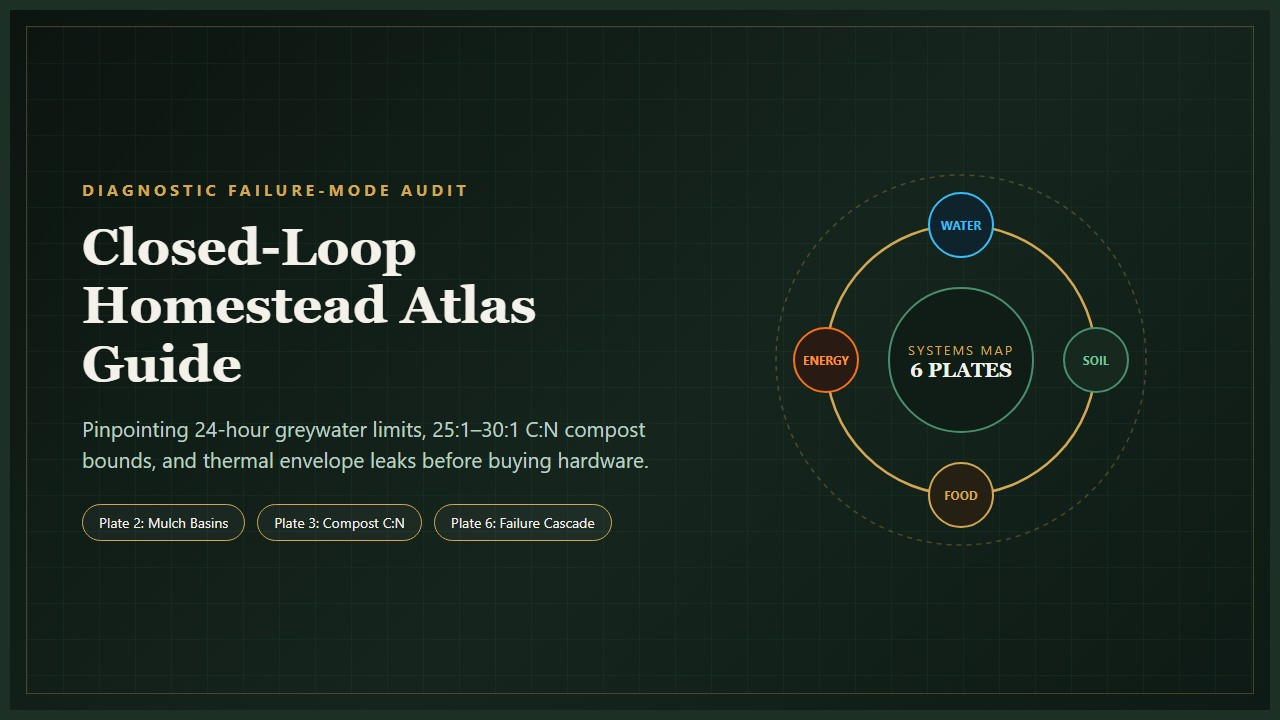
The Closed-Loop Homestead Atlas: Diagnostic Failure-Mode Audit
A 6-plate systems audit of household greywater, 25:1–30:1 compost, permaculture zones, and thermal envelope boundaries from The Closed-Loop Homestead Atlas.
By Ace Bailey Published November 28, 2026 1:26 PM Updated November 28, 2026 4 min read
A 6-plate systems audit of household greywater, 25:1–30:1 compost, permaculture zones, and thermal envelope boundaries from The Closed-Loop Homestead Atlas.
Why Disconnected Homestead Systems Stall
Most residential water, soil, food, and energy advice fails because it treats each household flow as an isolated project. Homeowners install rain barrels without overflow routing, build compost bins without carbon-to-nitrogen balance, or size solar hardware before sealing air leaks in the building envelope. In The Closed-Loop Homestead Atlas, these breakdowns are mapped as a single metabolic system where every output becomes either a productive input for the next plate or a preventable failure cascade.
Quick Scan
- Core Bottleneck: Disconnected household loops turn free outputs (rainwater, laundry wash water, kitchen scraps) into standing waste and added chores.
- Primary Thresholds: Never hold untreated greywater past 24 hours; keep active compost at 25:1–30:1 C:N and 70%–80% moisture; seal envelope drafts before sizing solar.
- Scope Boundary: Visual household-scale reference—not a substitute for structural engineering or permitted blackwater septic design.
Three Structural Failure Modes in Household Loops
- Unrouted Greywater Storage Past 24 Hours: Routing laundry or shower water into sealed holding tanks instead of direct wood-chip mulch basins turns organic soap and lint loads anaerobic within a single day, creating foul odors and soil-clogging biofilms.
- Carbon-Starved or Saturated Compost Zones: Dumping kitchen greens without matching high-carbon browns pushes the C:N ratio out of the 25:1–30:1 thermophilic window, while moisture outside the 70%–80% squeeze-test boundary stalls decomposition or triggers sour leachate.
- Oversized Hardware Over an Unsealed Thermal Envelope: Adding battery banks, heat pumps, or supplemental heaters before sealing door sweeps, window drafts, and high-sun overhangs forces mechanical equipment to fight continuous conductive and convective losses.
Homestead Loop Diagnostic Matrix
Use these observable signals from Plates 1 through 6 of the Atlas to isolate where a loop has broken before buying new equipment:
| Atlas Plate | Observable Symptom | Underlying Breakpoint | Corrective Boundary |
|---|---|---|---|
| Plate 2: Water & Greywater | Sour odor or standing water in holding tank | Greywater held past 24-hour anaerobic threshold | Route through a 2-way diverter directly to wood-chip mulch basins |
| Plate 3: Soil & Compost | Ammonia smell or compacted wet pile | Excess nitrogen greens or moisture above 80% | Layer shredded leaves/wood chips to restore 25:1–30:1 C:N balance |
| Plate 4: Food & Zones | Wilting herbs or neglected outer beds | High-maintenance crops placed in Zone 3–4 | Move daily-harvest greens into Zone 1 kitchen-door microclimates |
| Plate 5: Thermal Envelope | High afternoon cooling load and winter drafts | Unshaded west/south glazing and unsealed penetrations | Install summer overhang shading and gasket-seal envelope leaks first |
| Plate 6: Failure Cascade | One stalled loop triggers secondary pest or root rot | No overflow buffer between connected plates | Establish daylighted emergency overflow paths on cisterns and basins |
What This Systems Atlas Does Not Claim
The Closed-Loop Homestead Atlas is a visual engineering reference for household-scale water, compost, permaculture zoning, and passive thermal boundaries. It does not replace licensed structural engineering, municipal plumbing code permitting for blackwater systems, or site-specific soil percolation testing where local ordinances mandate certified septic engineering.
How do I tell a broken household loop from normal seasonal variance?
Normal seasonal variance changes flow volume—such as lower rainwater harvest during dry months or slower winter compost activity—without degrading soil biology or indoor air quality. A broken loop shows a persistent boundary violation: anaerobic odors in greywater basins, standing leachate around compost bays, or indoor temperature swings that persist after basic air sealing.
Which warning signs mean I should bypass a greywater or compost loop immediately?
Bypass greywater to the municipal sewer or septic line immediately if wash loads contain bleach, boron-heavy detergents, diapers, or persistent grease, or if mulch basins fail to drain between cycles. Pause compost loading if rodent burrowing or anaerobic runoff appears, and restore dry carbon cover before resuming kitchen-scrap additions.
Why does the Atlas sequence envelope sealing before solar or battery sizing?
Every unit of heat gained or lost through unsealed framing, uninsulated attic hatches, or unshaded glass multiplies the storage capacity required from off-grid electrical hardware. Sealing air leaks and establishing passive solar overhangs first lowers the baseline load so any downstream energy system stays smaller, simpler, and easier to maintain.
Reference & Interactive Tools
Explore the 6 interactive SVG plates, printable reference sheets, and failure-cascade lookup inside The Closed-Loop Homestead Atlas, or test related household diagnostics in the Interactive Knowledge Lab.