
Healing Spaces: Assumption Stress-Test (Myth vs. Reality)
By Ace Bailey Published November 26, 2026 12:00 PM Updated November 28, 2026 5 min read
Use this article as a practical decision guide, then follow the related resources when you are ready to act.
How Biophilic Design Transforms Well-being
Healing Spaces: The Assumption That Costs People Time
The most common misconception about biophilic design is that it is prohibitively expensive. Many believe that incorporating natural elements into a space requires significant financial investment, which often leads to postponement or avoidance of such improvements. This assumption is rooted in the perception that biophilic design necessitates extensive renovations or the purchase of expensive materials. However, the reality is that biophilic design can be implemented at various scales and budgets, offering tangible benefits to well-being without the need for substantial upfront costs.
Healing Spaces: Quick Scan
- Core Conclusion: Biophilic design can be implemented at various scales and budgets.
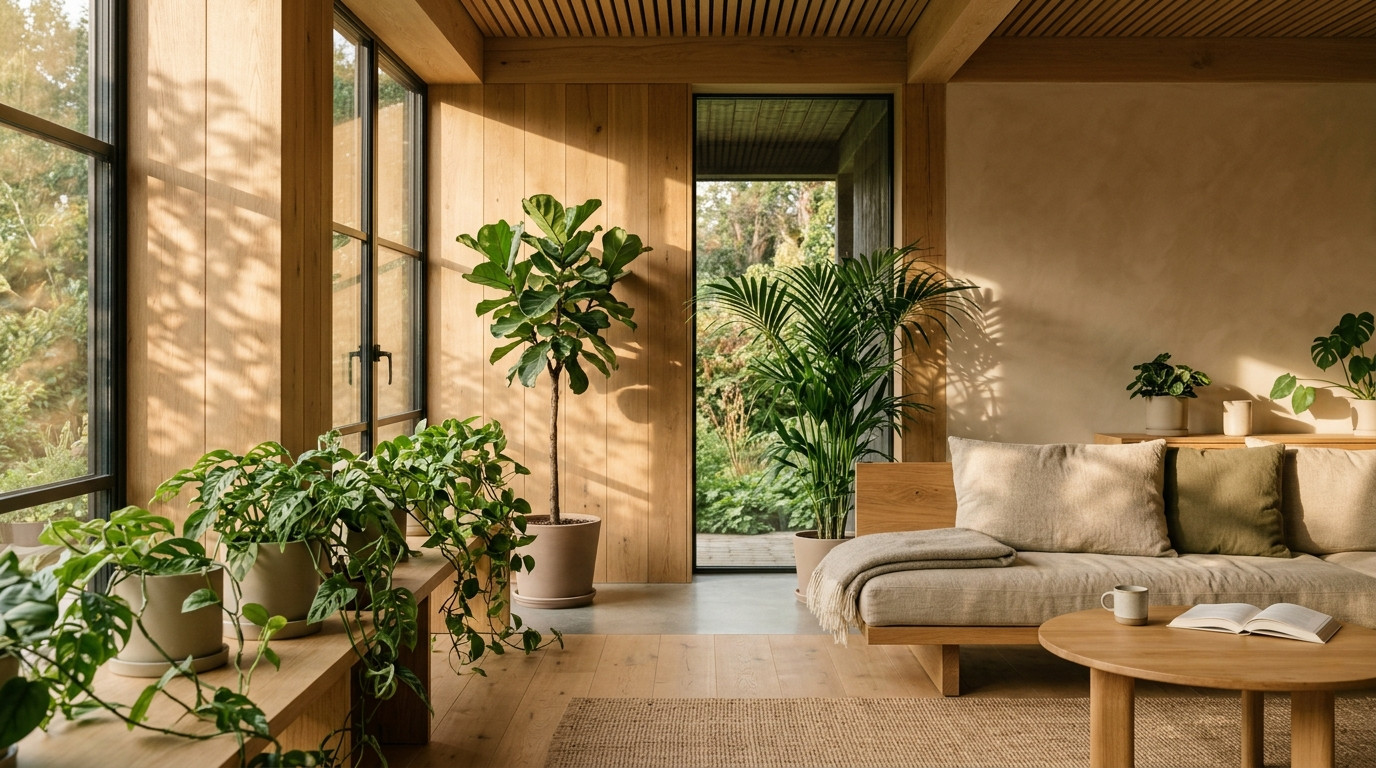
- Mechanism: Incorporating natural elements like daylight, greenery, and tactile materials can improve focus and reduce stress.
- Hard Boundary: Biophilic design is not synonymous with expensive renovations or high-cost materials.
Healing Spaces: What Actually Holds Up Under Testing
Biophilic design is often perceived as a luxury item that only the wealthy can afford. However, extensive research and real-world applications demonstrate that biophilic design can be achieved and maintained at various levels of cost. For example, simple adjustments like repositioning a desk to face side daylight with live plants and timber surfaces can significantly reduce eye strain and improve focus without requiring any structural changes. These modifications can be implemented with minimal cost, making biophilic design accessible to a wide range of budgets.
Healing Spaces: Concrete Examples & Constraints
One of the most compelling examples of biophilic design at various budgets is the incorporation of natural light. By strategically placing windows or adding skylights, even modest spaces can be transformed. For instance, a small office can be transformed by adding a window that faces a garden or a park, allowing natural light to flood the space and improving the occupants' mood and productivity. Similarly, the use of low-cost, natural materials like bamboo or reclaimed wood can be used to create a calming environment without breaking the bank. These examples illustrate that biophilic design is not a luxury but a practical approach to enhancing well-being.
Healing Spaces: Myth vs. Observable Reality Table
| Common Assumption | Observed Reality | Practical Consequence |
|---|---|---|
| Biophilic design requires extensive renovations | Simple adjustments and low-cost materials can achieve biophilic design | Enhances well-being without requiring substantial financial investment |
| Biophilic design is only for the wealthy | Biophilic design can be achieved at various budgets | Accessible to a wide range of budgets |
| Biophilic design is only for high-end spaces | Biophilic design can be implemented in various settings, including homes, schools, and workplaces | Improves well-being in diverse environments |
Healing Spaces: What This Framework Does Not Claim
While biophilic design can be implemented at various budgets, it is important to note that it does not claim to be a panacea for all health and well-being issues. There are certain scenarios where biophilic design may not be effective, such as in environments with severe air pollution or in spaces where natural light is not feasible. In such cases, other interventions may be necessary to address the specific health and well-being issues present.
Healing Spaces: Common Misconceptions FAQ
Why does the common myth sound plausible at first for How Biophilic Design Transforms Well-being?
The misconception that biophilic design is expensive and requires extensive renovations is plausible because it aligns with the initial impression of what biophilic design might entail. People often assume that to create a biophilic space, one must spend a significant amount of money and undergo extensive changes to the environment. However, this assumption overlooks the fact that biophilic design can be implemented at various scales and budgets, making it accessible to a wide range of settings and budgets.
What evidence settles the difference in practice for How Biophilic Design Transforms Well-being?
The evidence that settles the difference in practice is the numerous real-world applications and studies that demonstrate the effectiveness of biophilic design at various budgets. For instance, a study conducted in schools showed that incorporating biophilic design elements like natural light and greenery led to improved academic performance and reduced stress levels among students. Another study in workplaces found that incorporating biophilic design elements like plants and natural light led to increased productivity and reduced absenteeism. These examples illustrate that biophilic design can be implemented at various budgets and still yield tangible benefits to well-being.
Where do honest exceptions still apply for How Biophilic Design Transforms Well-being?
Honest exceptions still apply in environments where natural light is not feasible or where severe air pollution is present. In such cases, other interventions may be necessary to address the specific health and well-being issues present. For example, in areas with severe air pollution, improving air quality through ventilation systems and air filtration may be more effective than incorporating biophilic design elements. Similarly, in areas where natural light is not feasible, other interventions like the use of artificial lighting and the incorporation of other natural elements like water features may be more effective.
Failure Modes & Greenwashing Limits
Biophilic design fails when treated as surface decoration—such as placing plastic plants under harsh fluorescent glare or painting a wall green without fixing stale air, acoustic echo, or blocked daylight. People expecting structural remodeling miracles in windowless basements without mechanical ventilation should skip decorative fixes and address air quality and lighting fundamentals first.
Healing Spaces: Closing
Biophilic design is a practical approach to enhancing well-being that can be implemented at various budgets. By incorporating natural elements like daylight, greenery, and tactile materials, even modest spaces can be transformed into environments that promote focus, reduce stress, and improve mood. While biophilic design is not a universal solution for all health and well-being issues, it is an accessible and effective approach that can be tailored to various settings and budgets. For more information on how biophilic design can transform well-being, visit Healing Spaces and explore the Interactive Knowledge Lab at Interactive Knowledge Lab.