Essentials of Earthworks in Permaculture: Tradeoff & Option Evaluation Guide
By Ace Bailey Published November 26, 2026 12:00 PM Updated November 28, 2026 4 min read
Use this article as a practical decision guide, then follow the related resources when you are ready to act.
Land Sculpting for Sustainability: The Core Tradeoff in Plain English
- Core conclusion: Earthworks succeed or fail on slope angle, soil percolation, and overflow spillways before a shovel ever hits the ground.
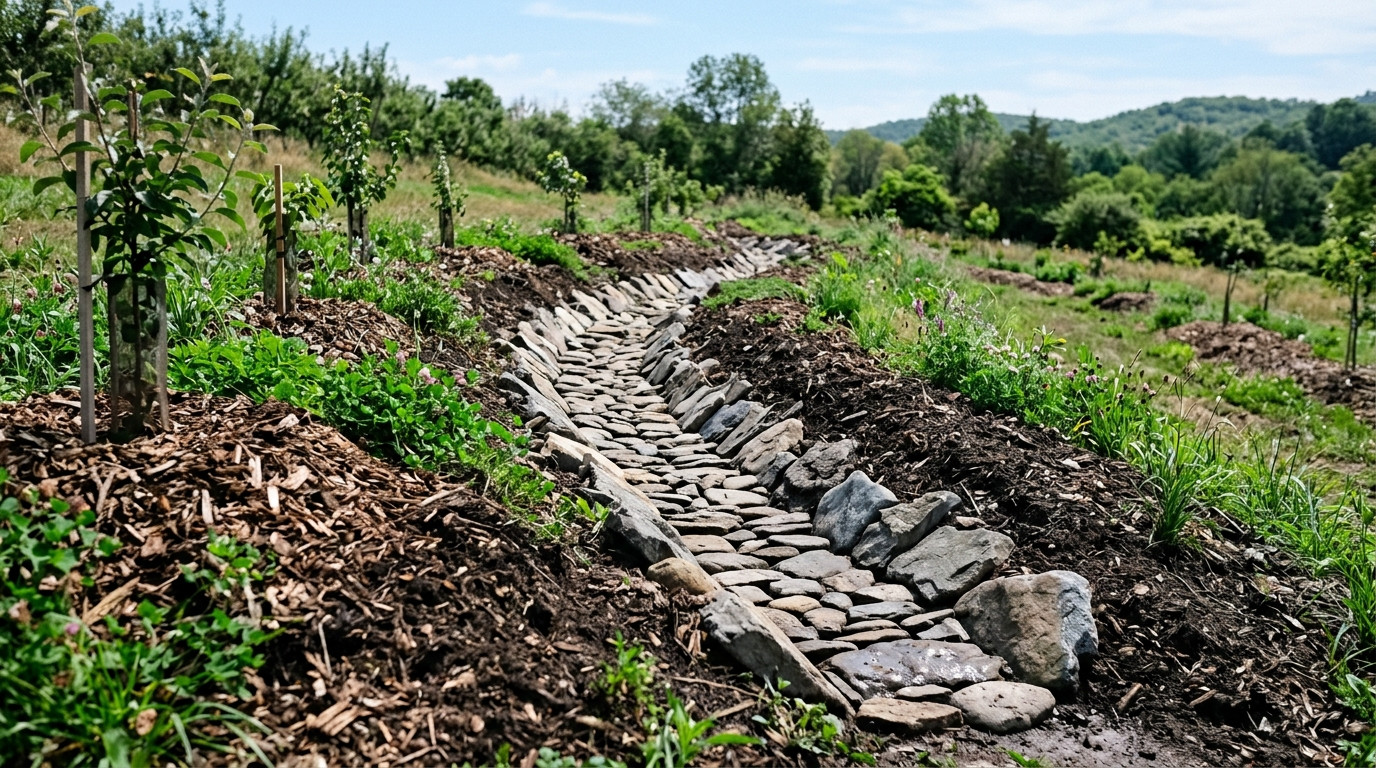
- Primary mechanism: Level contour swales and keyline grading slow runoff so rainwater infiltrates into root zones instead of washing topsoil downhill.
- Hard boundary: Never cut contour swales on slopes steeper than 15 degrees or dispersive clay without an armored spillway and drainage assessment.
In "Land Sculpting for Sustainability" by Ace Bailey, the core tradeoff in earthworks for permaculture design centers around the balance between labor and materials efficiency, and the precision required to manage water flow and soil health. The primary option is to meticulously plan and execute earthworks, while the alternative is to rely on natural water flow and soil conditions without significant human intervention. The core tradeoff is not about choosing between doing nothing and doing everything, but rather between a labor-intensive, precise approach and a more natural, less planned method.
Land Sculpting for Sustainability: Option A vs. Option B Under Real Constraints
Option A, the meticulous approach, involves detailed assessments of slope, soil type, and water flow before any digging begins. This includes creating contour swales, terraces, and keyline designs to manage water efficiently. Option B, the natural approach, relies on the natural movement of water and soil, often without significant human intervention beyond initial site preparation. The main constraint in Option A is the need for skilled labor and precise planning, while Option B requires a deep understanding of site conditions and the ability to observe and adapt to natural processes.
Land Sculpting for Sustainability: Evidence & Concrete Numbers from the Field
Ace Bailey's work emphasizes the importance of understanding the specific conditions of the site, such as slope angle and soil percolation rates. For instance, in "Assessing Slope," Bailey outlines the critical importance of not exceeding 15 degrees for contour swales on slopes, as steeper angles increase the risk of water ponding and soil erosion. Bailey also discusses the need for armored spillways to manage water overflow, which can be costly and labor-intensive. On the other hand, the natural approach often relies on the natural movement of water, which can be observed and adapted to without significant upfront investment. However, this approach requires a deep understanding of the site's hydrology and soil conditions, which can be challenging to achieve without detailed assessments.
Land Sculpting for Sustainability: Side-by-Side Tradeoff Matrix
| Approach | Primary Upside | Hidden Cost / Risk |
|---|---|---|
| Meticulous Planning (Option A) | Precise control over water flow and soil health | High labor and material costs, requires skilled labor and detailed planning |
| Natural Approach (Option B) | Minimal labor and material costs, relies on natural processes | Risk of water ponding and soil erosion, requires understanding of site conditions and natural processes |
Land Sculpting for Sustainability: Inverted Relevance: Who Should Choose Differently
The choice between Option A and Option B often depends on the specific site conditions and the available resources. For sites with steep slopes or dispersive clay, meticulous planning is essential to prevent water ponding and soil erosion. In these cases, the labor and material costs are justified by the need for precision and safety. Conversely, for sites with gentle slopes and well-drained soils, the natural approach can be more cost-effective and less labor-intensive. However, this approach requires a deep understanding of site conditions and the ability to observe and adapt to natural processes.
Land Sculpting for Sustainability: Decision FAQ
Which earthworks option holds up best under low resources?
In low-resource scenarios, working with natural water flow and minimal grading often holds up best, provided you observe site drainage patterns across a few rain events before modifying slopes.
What hidden cost do people overlook most often in earthworks?
People often overlook the labor, machine time, and armored-spillway rock costs required to keep contour swales safe during heavy storm overflow.
When is doing nothing the rational choice?
If existing vegetation and gentle slopes already infiltrate water without erosion or foundation pooling, leaving the ground undisturbed avoids unnecessary soil disturbance and cost.
Further reading: Interactive Knowledge Lab and Daily Discovery Center.