
Why Closed-Loop Homesteads Cut Maintenance Time Instead of Adding Chores
Field notes on why gravity-fed greywater mulch basins, Zone 1 proximity, and passive thermal envelopes reduce daily homestead upkeep.
By Ace Bailey Published November 28, 2026 1:26 PM Updated November 28, 2026 4 min read
Field notes on why gravity-fed greywater mulch basins, Zone 1 proximity, and passive thermal envelopes reduce daily homestead upkeep.
The Homestead Complexity Assumption That Wastes Time
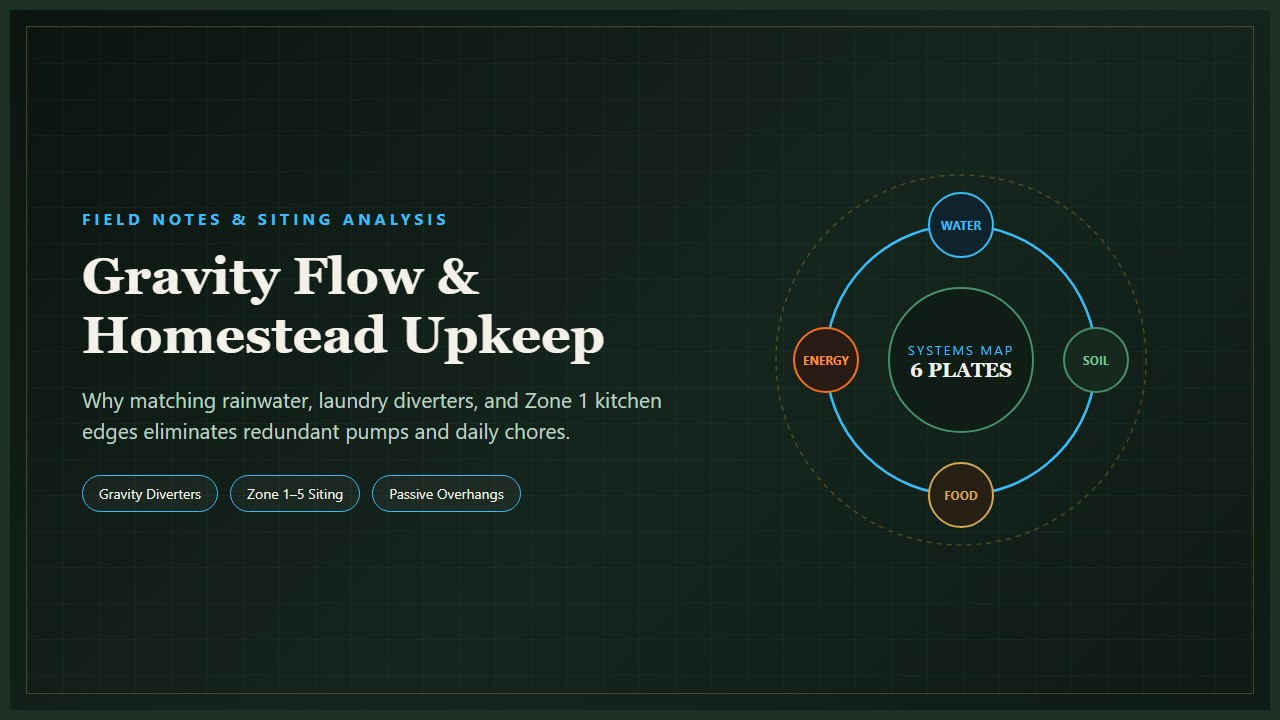
A common assumption about closed-loop living is that integrating water, soil, food, and thermal systems requires constant daily labor and complex monitoring. In practice, most of that perceived workload comes from building disconnected, high-maintenance components—such as pumping small tanks, hauling compost across distant yard zones, or compensating for unshaded walls with mechanical cooling. When household flows are laid out visually as connected loops, daily maintenance drops because gravity, biology, and proximity do the work.
Quick Scan
- Core Conclusion: Well-sited closed-loop systems reduce daily chores by eliminating redundant pumps, tanks, and long-haul transport.
- Mechanism: Every output from one plate—roof runoff, laundry greywater, kitchen scraps, or winter sun—feeds an adjacent zone directly.
- Hard Boundary: Simplicity holds only when biological thresholds (such as the 24-hour greywater limit and 25:1–30:1 C:N ratio) are respected at design time.
What Holds Up Under Field Observation
Field layouts modeled in The Closed-Loop Homestead Atlas show that labor spikes happen when placement ignores frequency of use and gravity flow. Routing washing-machine discharge through a manual two-way diverter straight into mulched fruit-tree basins removes pump maintenance, filter cartridges, and holding-tank cleanouts in a single step. Similarly, placing culinary herbs and cut-and-come-again greens in Zone 1 right outside the kitchen door turns watering and harvesting into a two-minute habit rather than a neglected chore at the back fence.
Concrete Siting Examples & Constraints
- Gravity-Fed Greywater: Directing laundry wash water into wood-chip mulch basins around Zone 3 perennial trees keeps biological filtration in aerobic topsoil rather than inside plastic barrels where water turns septic after 24 hours.
- Thermophilic Compost Balance: Maintaining a 25:1–30:1 carbon-to-nitrogen ratio with 70%–80% moisture (wet as a wrung-out sponge) prevents odor and fly issues without daily turning or motorized tumblers.
- Climate & Site Constraints: Heavy clay soils with slow percolation, sub-freezing winter pipe runs, and strict HOA or municipal greywater codes require seasonal valve bypasses and larger mulch-basin surface areas.
Assumption vs. Observed Homestead Reality
| Common Assumption | Observed Field Reality | Practical Consequence |
|---|---|---|
| Closed-loop water requires storage tanks and pumps | Direct gravity diverters feed mulch basins immediately | Eliminates septic tank odors and pump failures |
| Productive food gardens need distant full-acre plots | High-yield daily crops thrive in Zone 1 kitchen edges | Cuts watering and harvest walking time dramatically |
| Energy resilience starts with buying solar panels | Passive overhangs and air sealing cut loads first | Shrinks required battery and inverter capacity |
| Composting needs daily mechanical turning | Balanced 25:1–30:1 C:N piles self-regulate heat | Reduces physical labor while building richer humus |
What This Field Analysis Does Not Claim
Connecting household loops lowers recurring upkeep, but it does not eliminate upfront layout work or seasonal inspections. Initial trenching for mulch basins, sealing thermal envelope bypasses, and establishing dry carbon storage near compost bays still require deliberate setup. Extreme climates—such as prolonged monsoon saturation or deep winter freezes—also require switching diverter valves back to conventional drains during off-nominal weeks.
Why does the high-labor myth sound plausible at first?
People usually judge homesteading effort by watching unintegrated setups where water is hauled by hand, compost sits far from the kitchen, and equipment fails because loops were never matched to site conditions. Without a visual systems map, every added project feels like one more isolated chore list.
What field evidence settles the difference in practice?
Observed layouts across Plates 1 through 5 show that proximity and passive physics replace most active labor. When roof cisterns sit upslope of Zone 2 beds, laundry diverters feed Zone 3 tree basins by gravity, and eaves block high summer sun automatically, daily intervention shrinks to periodic valve checks and seasonal mulching.
Where do honest exceptions still apply?
Sites with zero slope, impermeable bedrock, high water tables, or severe winter freeze cycles cannot rely on year-round gravity infiltration alone. In those cases, seasonal bypasses, raised beds, and indoor thermal-mass buffers become necessary additions rather than optional upgrades.
Continue Exploring
Compare visual system layouts and household diagnostic calculators in the Interactive Knowledge Lab, explore daily field concepts in the Daily Discovery Center, or inspect the six-plate visual reference in The Closed-Loop Homestead Atlas for full cutaway diagrams and failure boundaries.