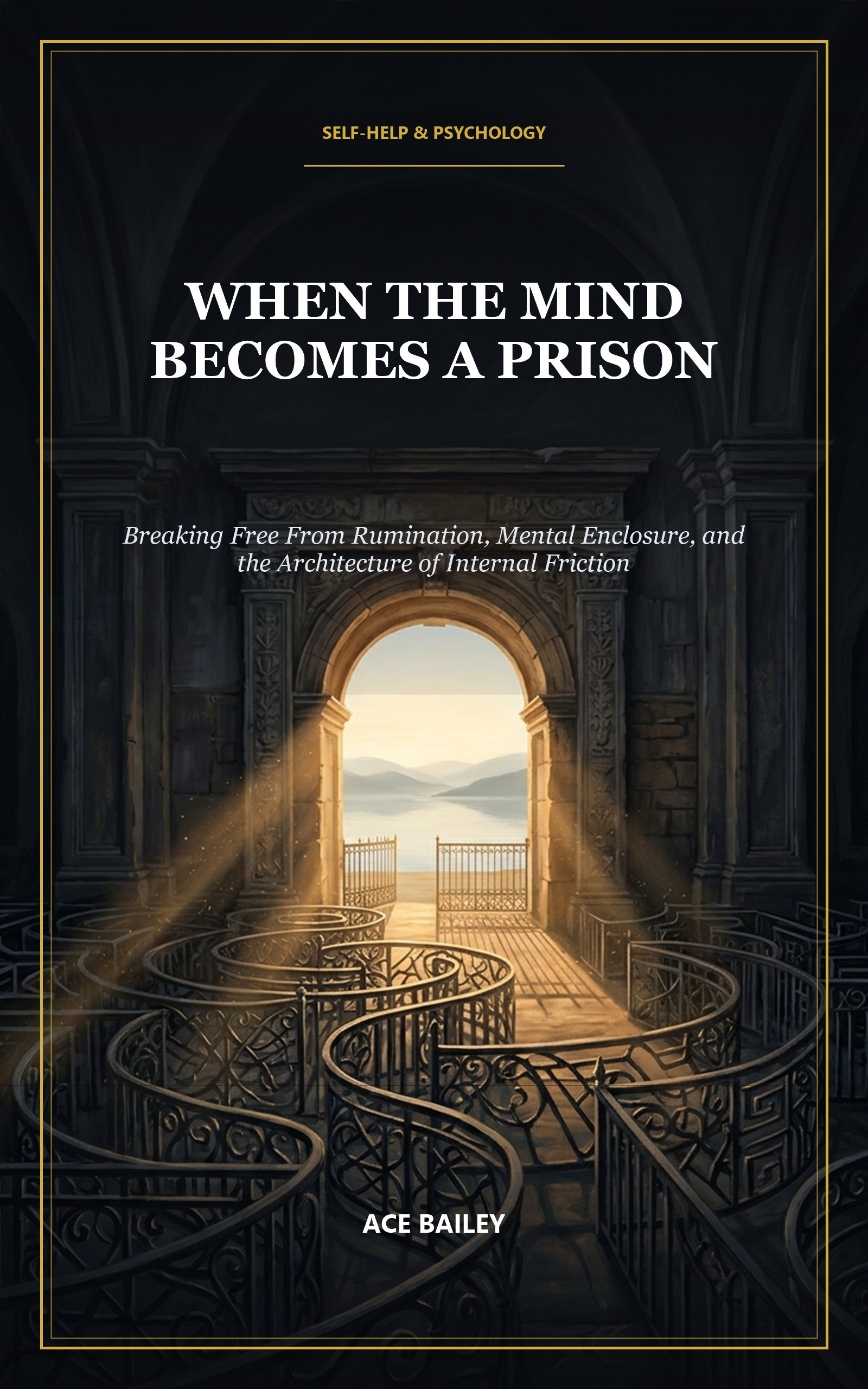
The sharpest intellect can become its own confinement when analytical thought turns into repetitive rumination. In When the Mind Becomes a Prison, author…
You want a structured, plain-English handbook you can download once, read offline, and apply step-by-step.
Skip This If
You are looking for overnight hype, passive entertainment, or licensed medical, legal, or financial counsel.
Inside This Guide
The sharpest intellect can become its own confinement when analytical thought turns into repetitive rumination. In When the Mind Becomes a Prison, author Ace Bailey presents Freedom Through Engagement—a practical psychological framework for breaking the cycle of cognitive loops. Learn how to shift from inward analysis to outward action, calm an overactive nervous system, and restore mental clarity.
Inside This Guide
The Prison Takes Shape: How Coping Becomes Confinement — Actionable framework and worked examples.
The Promise and Price of Avoidance — Actionable framework and worked examples.
When Thoughts Feel Like Facts — Actionable framework and worked examples.
The Emotions We Try Not to Feel — Actionable framework and worked examples.
The Freedom Through Engagement Model — Actionable framework and worked examples.
Rebuilding Connection, One Step at a Time — Actionable framework and worked examples.
Format & Delivery
Instant digital download (EPUB + print-ready PDF companion) from Ace Bailey (Independently Published).
About the Author
Ace Bailey is an author and behavioral researcher studying cognitive distortion patterns, attentional recovery, and mental resilience.
Related Items
Keep building with related resources from the store.
Listen to Chapter 1 (Audio Preview)
Read or listen at your own pace
Chapter 1 Free Sample
The Prison Takes Shape: How Coping Becomes Confinement
A prison of the mind rarely appears all at once. More often, it takes shape through small decisions that seem sensible at the time: postpone the call, avoid the gathering, keep the worry to yourself, wait until you feel more certain. Each choice may bring a little relief. But when the same choices repeat, they can gradually narrow the life around them.
This is not a story about weakness or failure. People develop ways of coping because something feels difficult, uncertain, or painful. A strategy that once helped may even have been necessary. The trouble begins when it becomes the only strategy available—when protection starts to prevent not just hurt, but also connection, discovery, and change.
Consider Maya, who has worked in a stable job for several years. Lately she has wondered whether she wants a different career. She reads about training programs, saves job listings, and imagines conversations with her manager. But every option seems to carry a risk: choosing the wrong path, losing income, disappointing her family, or discovering she is not capable of something new. So she decides to wait until she feels sure.
Waiting brings relief. She does not have to face a difficult decision today. Yet weeks become months. The more she postpones, the more consequential the choice seems, and the less confident she feels about making it. Her world has not collapsed. From the outside, she may look responsible and settled. Inside, though, the range of possibilities she can imagine is shrinking.
Maya’s experience is not unusual, and it does not by itself mean she has a mental health disorder. Uncertainty is part of ordinary life. Worry can help us prepare, and taking time before a major decision can be wise. The important question is not whether a person ever feels anxious or gets stuck. It is whether a pattern repeatedly keeps them from living in ways that matter to them.
Several experiences can contribute to that pattern, and they are not all the same. Worry often focuses on possible future problems: What if I make a mistake? What if things go badly? It may prompt useful preparation, but it can also keep the mind rehearsing dangers without reaching a decision.
Rumination tends to circle around what has already happened or what something might mean. A person may replay a conversation, searching for the moment they sounded foolish, or return again and again to the question of why a relationship changed. Reflection can help us learn. Rumination feels more like being caught in the same loop, with little new understanding emerging.
Anxiety is a feeling of unease or alarm that may involve thoughts, bodily sensations, or both. It can arise in response to a real challenge, an imagined possibility, or a situation whose outcome is unknown. Feeling anxious is not proof that danger is present, nor is it automatically evidence of illness.
Avoidance is a response: stepping away from a situation, thought, feeling, or task because it seems difficult to face. Sometimes avoiding something is sensible. Leaving an unsafe situation, declining an unreasonable demand, or taking a break can be protective. But avoidance can become restrictive when it repeatedly blocks ordinary, meaningful activities.
Social withdrawal is one possible form. Someone may stop accepting invitations because they fear being awkward or burdensome. Emotional suppression is another: a person may hide sadness, anger, or fear, even from themselves, in an effort to stay composed. These responses can offer immediate protection. They can also make it harder to seek support, understand what is needed, or discover that a feared situation may be manageable.
The distinction lies not in labeling a behavior as good or bad, but in noticing its effects. Does it help you respond to the situation, or does it mainly help you escape the feeling for a moment? Does it leave you with more room to choose next time, or less?
For Maya, postponing the career question reduces pressure in the short term. But postponement also prevents her from gathering information that could make the choice clearer. She could speak with someone in the field, explore a course without enrolling, or ask her manager about a different responsibility. None of these steps would force her to quit. They might simply help her replace an imagined, all-or-nothing decision with smaller questions she can actually investigate.
End of Chapter 1 preview. Get the full 7-chapter digital edition (EPUB & PDF) below.