You want a structured, plain-English handbook you can download once, read offline, and apply step-by-step.
Skip This If
You are looking for overnight hype, passive entertainment, or licensed medical, legal, or financial counsel.
Inside This Guide
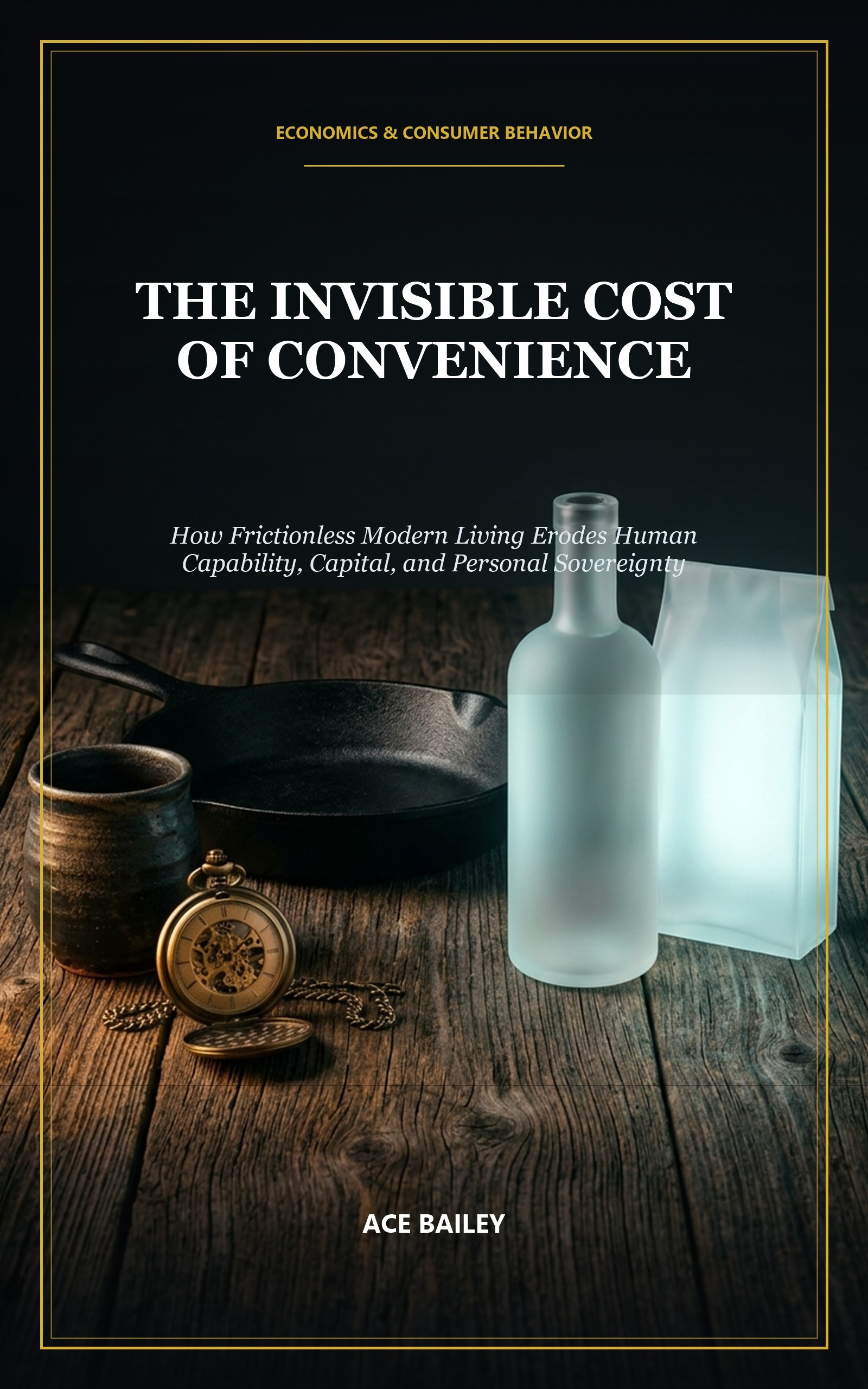
Modern consumer society promises that friction is the ultimate enemy. In The Invisible Cost of Convenience, author Ace Bailey reveals the compounding tradeoffs hidden behind subscription defaults, on-demand services, and outsourced household capabilities. Learn how to calculate the true Convenience Exchange Equation, audit recurring attention drains, and reclaim the tangible skills that preserve domestic independence.
Inside This Guide
The Price Beyond the Price Tag — Actionable framework and worked examples.
How Frictionless Choices Become Habits — Actionable framework and worked examples.
The Convenience Exchange Equation — Actionable framework and worked examples.
When Convenience Is Worth It — Actionable framework and worked examples.
What We Give Up When We Outsource — Actionable framework and worked examples.
Finding the Leaks and Rebuilding Choice — Actionable framework and worked examples.
Format & Delivery
Instant digital download (EPUB + print-ready PDF companion) from Ace Bailey (Independently Published).
About the Author
Ace Bailey is an author, economic researcher, and systems thinker examining consumer economics, technological dependence, and personal self-reliance.
Related Items
Keep building with related resources from the store.
Listen to Chapter 1 (Audio Preview)
Read or listen at your own pace
Chapter 1 Free Sample
The Price Beyond the Price Tag
Convenience has a price. Often, we can see it clearly: the delivery fee, the monthly subscription, the higher cost of a ready-made meal. But the amount charged at checkout is only the beginning. A purchase can also take time, attention, flexibility, and skills. It can make us dependent on a provider or quietly crowd out other uses for our money. To understand what convenience is worth, we have to count not only what we pay, but what we give up.
Consider a meal delivered to your door. Its price may include the food, a service charge, a delivery fee, and a tip. There may also be a higher menu price than you would pay in the restaurant. These costs are visible, at least if you look closely. Less obvious is the time spent choosing among options, tracking the order, and dealing with a mistake. If delivery becomes the default, you may also lose opportunities to learn a few reliable meals or to enjoy cooking with someone else. None of this means delivery is a bad choice. It means the choice is larger than the number on the receipt.
The same is true of subscriptions. A streaming service or software plan may seem inexpensive month by month. Because the charge is small and automatic, it can fade from notice. Months later, you may be paying for several services you rarely use. The total cost includes not just the fees, but the attention required to keep track of them and the effort involved in canceling. A subscription can also make switching feel harder: your saved playlists, files, or routines may be tied to one provider. What began as a convenient trial can become a quiet commitment.
Small costs matter especially when they repeat. A few dollars here and there can seem harmless in isolation, but recurring expenses accumulate. The point is not to treat every small purchase as a threat. A modest fee may be an excellent trade if it saves time you genuinely need or makes an important task possible. The point is to notice repetition. A choice made once is not the same as a choice that renews every month without being reconsidered.
There are costs that do not appear on a bill at all. A disposable product may save a few minutes today, but require frequent replacement and generate waste. A household service may remove an unpleasant chore, but leave you unsure how to handle it if the provider becomes unavailable. A digital tool may organize your schedule while drawing you into a stream of alerts and recommendations. The convenience is real; so is the resource it consumes.
Time is one of the most important parts of the calculation. People often pay for convenience because they are busy, and sometimes that is entirely sensible. If a service gives a caregiver an hour to rest, or helps someone with limited mobility get groceries, the time saved may be invaluable. But not all saved time becomes useful time. A faster purchase might lead to more browsing, more messages, or another task. The minutes saved can disappear into the same systems that made the purchase easy.
Attention has a cost, too. Every service asks for some share of it: a notification to read, a renewal to remember, a choice to make, a problem to solve. These demands are easy to underestimate because they arrive in fragments. Yet a life full of small interruptions can feel surprisingly crowded. A convenient product may reduce effort in one area while adding decisions elsewhere. The useful question is not simply, “How much time does this save?” but also, “What will this choice ask me to notice, manage, or remember?”
Then there is opportunity cost: what the money, time, or attention could have supported instead. A monthly fee might be worth keeping, but it could also be funding a service you no longer value. A ride may be the right choice on a difficult day, while frequent rides might make it harder to afford something more important. Opportunity cost is not always a reason to say no. It is a reminder that every yes uses resources that cannot be used twice.
Convenience can also change what feels possible. When a service handles a task repeatedly, we may stop practicing it. That can be a relief, especially when the task is exhausting or inaccessible. It can also leave us less prepared if prices rise, a provider changes its terms, or the service disappears. Dependence is not automatically harmful; many useful parts of modern life depend on other people and systems. The question is whether we understand the dependence and accept its risks.
A fuller price tag, then, has several parts: money, time, attention, flexibility, capability, and the alternatives we forgo. Not every part needs to be measured precisely. Even a rough estimate can change how a decision looks. A service that costs more in dollars may still be the better value if it protects your health or frees time for work, family, or rest. A cheaper option may be more costly if it demands hours you do not have. The goal is not to prove that convenience is wasteful. It is to see the exchange clearly.
This book is about that exchange. The invisible cost of convenience is not a reason to reject useful services or return to doing everything the hard way. It is a reason to choose with open eyes. When we count what a purchase gives as well as what it takes, we can distinguish genuine support from spending that continues only because it is easy to overlook. Convenience is most valuable when its benefits are real, its costs are understood, and the decision still belongs to us.
Calculating How Frictionless Living Erodes Human Capability
End of Chapter 1 preview. Get the full 7-chapter digital edition (EPUB & PDF) below.