We live in an age of constant stimulation, yet genuine observation has never been rarer. In The Forgotten Science of Observation, author Ace Bailey presents…
You want a structured, plain-English handbook you can download once, read offline, and apply step-by-step.
Skip This If
You are looking for overnight hype, passive entertainment, or licensed medical, legal, or financial counsel.
Inside This Guide
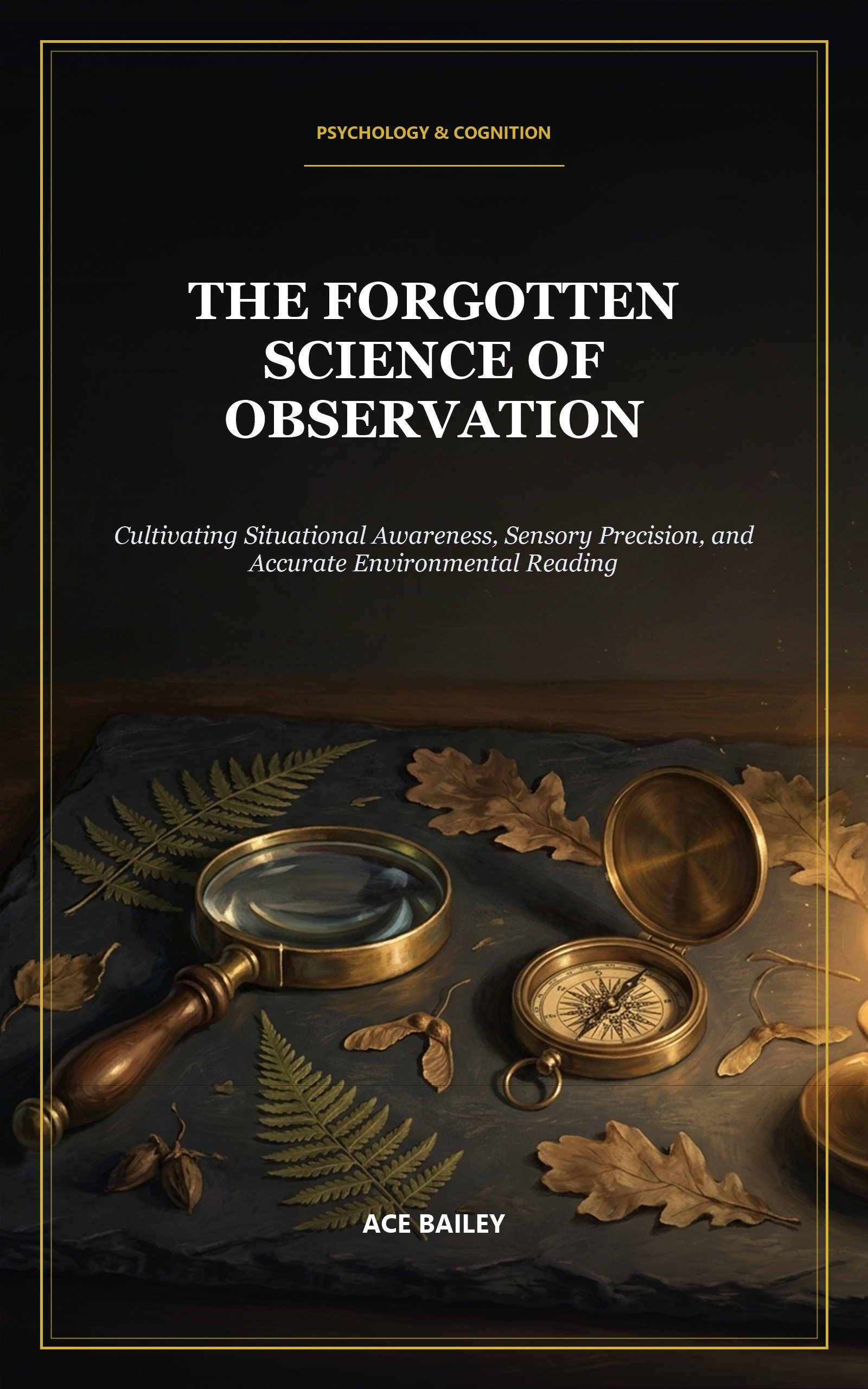
We live in an age of constant stimulation, yet genuine observation has never been rarer. In The Forgotten Science of Observation, author Ace Bailey presents a disciplined system for retraining human attention. Through the Seven Layers of Observation, learn how field naturalists, forensic analysts, and elite operators interpret subtle sensory cues, dismantle cognitive blindspots, and see what others miss.
Inside This Guide
Seeing Is Not the Same as Observing — Actionable framework and worked examples.
The Mind’s Blind Spots — Actionable framework and worked examples.
A Long History of Learning to Notice — Actionable framework and worked examples.
The Seven Layers of Observation — Actionable framework and worked examples.
Reading Materials, Landscapes, and Customers — Actionable framework and worked examples.
Practicing Observation in Daily Life — Actionable framework and worked examples.
Format & Delivery
Instant digital download (EPUB + print-ready PDF companion) from Ace Bailey (Independently Published).
About the Author
Ace Bailey is an author, field observer, and researcher investigating cognitive psychology, perceptual acuity, and environmental reading.
Related Items
Keep building with related resources from the store.
Listen to Chapter 1 (Audio Preview)
Read or listen at your own pace
Chapter 1 Free Sample
Seeing Is Not the Same as Observing
At the end of a familiar street, a small tree leans over a fence. You pass it every day. You know it is there, just as you know the shop on the corner and the crack in the pavement. But one morning you notice that its leaves have curled inward, though the neighboring trees look healthy. You stop. The soil beneath it is dry. A hose lies coiled nearby, untouched.
Until that moment, you had looked at the tree many times. Now you are observing it.
The difference may seem small, but it changes what becomes available to you. Looking is often brief and automatic. It lets us move through the world without having to examine everything. Noticing happens when something catches our attention: a change, a contrast, an unusual detail. Observing goes further. It means staying with what has caught our attention, describing it carefully, and asking what the evidence might—and might not—tell us.
Observation is not a rare gift reserved for artists, scientists, or detectives. It is a skill that can be learned. Like listening well or asking a useful question, it improves with practice. Yet it is easy to overlook because seeing feels effortless. We open our eyes and the world appears to arrive whole. We may assume that what we see is simply what is there.
It is not so simple. Our eyes receive details, but our minds select, arrange, and interpret them. We fill gaps with memory and expectation. We recognize a familiar scene and move on. We may see a person glance at a clock and decide they are impatient, or notice a dark cloud and conclude that rain is certain. Sometimes our conclusions are right. Sometimes they are merely plausible. The trouble begins when we mistake a plausible interpretation for a fact.
A disciplined observer pauses between the two.
Imagine that a colleague enters a meeting, sets down a bag, and says little. “She is angry,” you might think. But what did you actually observe? She entered, put down her bag, and spoke only once. Anger is an interpretation. She may be tired, distracted, worried, or simply quiet. Separating the visible details from the story we attach to them does not make us cold or indecisive. It makes our judgment more dependable.
This distinction matters because first impressions are efficient. They help us respond quickly, and often they serve us well. But speed comes at a cost: it can hide uncertainty. Careful observation asks us to slow down long enough to notice what supports a conclusion, what contradicts it, and what remains unknown. Patience is not a decorative quality here. It is part of how we gather better evidence.
Evidence begins with description. “The tree is dying” is a conclusion. “Several leaves are curled, the soil is dry, and the branches on the south side have fewer leaves than last week” is a record of what can be checked. The second account leaves room for further investigation. Perhaps the tree lacks water. Perhaps a pest is damaging it. Perhaps the change is seasonal. Description does not solve the question by itself, but it gives the question a sound starting point.
Observation also depends on comparison. A single detail can be hard to interpret. A plant’s drooping leaves may be normal in the afternoon but unusual in the morning. A machine’s vibration may be ordinary when it starts and concerning if it grows stronger over several days. We understand a detail better when we compare it with a previous condition, a nearby example, or an expected pattern. The more carefully we compare, the less likely we are to treat every difference as meaningful—or to miss a difference that matters.
This is why observation is active, not passive. The observer does not simply receive impressions. The observer chooses where to look, what to record, and which questions to pursue. Curiosity provides the first nudge: Why is this patch of grass greener? Why do customers keep asking for the same adjustment? Why does the door stick only when the weather is damp? But curiosity becomes useful when it is joined to patience and a willingness to test ideas.
A person who notices a recurring problem at work might initially blame carelessness. Instead of settling on that explanation, they could record when the problem occurs, which steps come before it, and whether it affects everyone or only certain shifts. The pattern may reveal that instructions are unclear, a tool is unreliable, or the process creates unnecessary pressure. The same habit applies in a garden, a workshop, a classroom, or a conversation. Look closely; describe what happened; compare cases; then consider what might explain them.
End of Chapter 1 preview. Get the full 7-chapter digital edition (EPUB & PDF) below.